History
St. Thomas the Apostle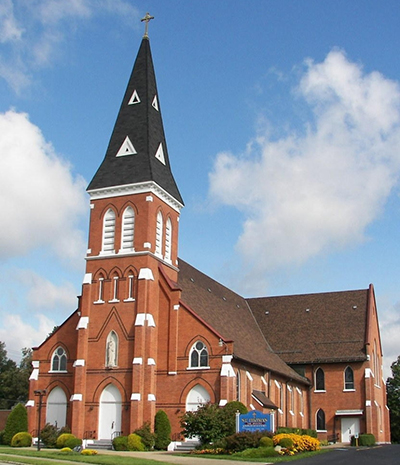 Catholics began arriving in what is now the Corry area in 1855, and so Saint Thomas the Apostle Parish was founded by the Diocese of Erie with Father Thomas Lonergan, an Irish-born priest as pastor (1855-1905), serving the immigrant population of the area by traveling on horseback.
The first Saint Thomas the Apostle Church, originally located on Fourth Avenue, was dedicated on September 7, 1862. Due to the increasing Catholic population, Father Lonergan built the present Saint Thomas the Apostle Church on West Washington Street. The church was finished and dedicated in December of 1885. The church went through substantial renovations over the years and was rededicated on February 18, 1996.
For many years, Saint Thomas the Apostle Church continued to grow. The parish had a convent of religious sisters who taught in the parish school. In addition, the parish established a mission church, Our Lady of Victory in Spartansburg, to provide for the pastoral care of the community which worshiped there.
The parish continued to provide pastoral care for the mission community in Spartansburg until the late 1980's, when the care of the mission was transferred to Saint Elizabeth Church, where it remained until Our Lady of Victory mission church was officially closed.
Priest who served Saint Thomas the Apostle Parish: Rev. Thomas Lonergan (1855-1905); Rev. Michael Tracy (1906-1927); Rev. Francis Graves (1927-1958); Rev. Cyril Cooper (1958-1980); Rev. Richard Mayer (1980-1991); Msgr. John Hagerty (1991-1997); Rev. William Kuba (1997-1998); Rev. Joseph Finucane (1998-2000); Rev. Thomas Brown (2000-2011); Msgr. Casimir Bogniak (2011-2012); Rev. Mark Hoffman (2012-2017); Rev. D.G. Davis, III (2017 - 2021); Rev. Matthew J. Strickenberger (2021-2022); and Rev. Thomas J. Whitman (2023 - present).
St. Teresa of Avila 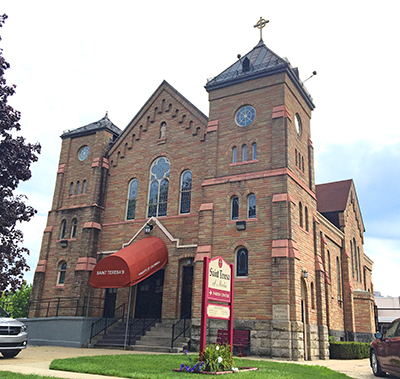 Irish Catholic families began arriving in Union Mills (later Union City) around 1854. Mass was celebrated in the homes of these early families by Father Emerand, a Benedictine priest. In 1857, twenty Catholic families petitioned for the founding of a church – the original St. Teresa’s – under the leadership of Fr. Thomas Lonergan. Before long the congregation outgrew the building and in 1860 a larger church was erected.
In the years 1868 and 1869 a series of priests served St. Teresa parish. They included Fr. Maloney, Fr. Maurel and Fr. Mada. In 1869 Fr. Dunn arrived and within a few years St. Teresa Parochial School was opened. The school was staffed by the Sisters of Saint Joseph and had an average enrollment of around 175 students.
Fr. Bernard Lynch served St. Teresa’s from 1892 to 1894. Fr. David Hanley came next and added a second story to the school as well as redecorating the church. At about the same time the school began to see a gradual decline in attendance, and was finally forced to close in August of 1901.
In 1897 Fr. James Fielding began the preliminary study for removing the wood-framed church building and replacing it with a sturdier and more permanent structure.
In 1904 Fr. Cantlin arrived and decided to go ahead and replace the old church building. In July of 1906 the cornerstone of the current church was laid and the building was completed and dedicated in May, 1907. Erie newspapers reported the cost of the building to be $16,000. A $2000 grant from Andrew Carnegie allowed the parish to purchase a Grand Tellers organ. Fr. Cantlin introduced catechism classes to the church, founded the Rosary-Altar Society in 1912, and oversaw the beginnings of the annual Lawn Festivals which always took place on a Thursday – a tradition that continues to this day. Fr. Cantlin was well-known and respected throughout the area. He anchored the parish and community through the First World War and the epidemic of Spanish influenza that immediately followed. It was the talk of the area that not a single St. Teresa parishioner died of influenza during the course of the epidemic. Fr. Cantlin served the parish until his death in 1930.
Fr. John Ring followed Fr. Cantlin, celebrating his first Mass at St. Teresa’s on Palm Sunday of 1930. A month later the church building was struck by lightning, resulting in a devastating fire. By October the church had been renovated and reopened for services. While repairs were being done the Presbyterian church opened its doors and allowed the parish to celebrate the Liturgy at their facility. Fr. Ring was noted for helping his parishioners through the Great Depression, and even sold his own life insurance policy and took little or no salary at times in order to keep the parish financially secure through this difficult period.
In 1941 Fr. Lawrence Trembly was assigned to St. Teresa’s and undertook the founding of the chapel of Our Lady of Fatima at Canadohta Lake. In 1952 the convent which had been closed with the closing of the school in 1901 was re-established. In 1954 Fr. Trembly died of a heart attack shortly before he was to deliver the baccalaureate address to the graduating class at Union City High School. A shaken community took up a collection in his memory which was used to automate the church bells and call people daily to the Angelus Prayer.
Two priests, Fr. Charles Hackerl and Fr. Malloy served as temporary pastors until Fr. Anthony Robaczewski arrived as permanent pastor in 1955. Under his leadership the church’s exterior was covered with bondstone and the interior of the building was refurbished. When Fr. Robaczewski became ill a series of priests came as temporary aides until Fr. Charles Skinner was finally appointed pastor in 1968. Under his pastorate Our Lady of Fatima Chapel was finally winterized. Fr. Skinner also headed a drive to preserve the local hospital.
After Fr. Skinner’s re-assignment to an Oil City parish, Fr. James Peterson was assigned as pastor of St. Teresa and Our Lady of Fatima, beginning his pastorate on June 27, 1975. Under Fr. “Pete” the convent was relocated, Lawn Festivals were revived, the cemetery was landscaped, and Horizon House – a facility for women in need – was created. The church was once again repainted on the inside and in 1984 a handicapped-accessible ramp was added to the north side of the church.
In September, 1985 Fr. Tom Smith came to the church as administrator and was named pastor ten months later. In September, 1986 it was discovered that the church’s side walls had moved to the point that the roof was in danger of collapsing into the church. The building had to be closed. In December of that year Fr. Dennis Martin came to St. Teresa’s. Because of the condition of the church building, services were held in the parish auditorium until the church’s walls could be reinforced and the building made safe for use.
In November, 1992 Fr. Paul Schill was assigned as temporary administrator of the parish until the appointment in January of 1993 of Fr. Dan Prez as pastor. During Fr. Prez’s pastorate the front of the church building was given a facelift, thermopane doors were installed at the church’s entrances, the parking lot was paved and landscaping improved.
In August, 1999 Fr. Tom Suppa arrived as pastor of St. Teresa and Our Lady of Fatima. Fr. Suppa revitalized the RCIA program and undertaken the refurbishing of the parish hall, including the addition of nine classrooms, a library, office space and a completely renovated kitchen. In 2007 the entire interior of the church building was re-plastered and repainted. On August 19th of that year St. Teresa’s celebrated its sesquicentennial.
Effective July 9, 2024, Saint Teresa of Avila Parish (Union City) was merged into Saint Thomas the Apostle Parish (Corry). Click here to read the decree.
Saint Elizabeth (1876 - 2019)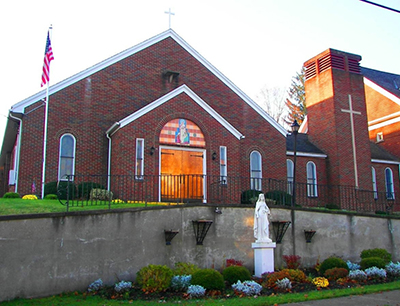 Saint Elizabeth Church was founded at the request of German immigrants, who settled in Corry. Under the patronage of Saint Elizabeth of Hungary, the Diocese established the parish; and the church and other buildings were completed prior to a pastor being assigned. With the work completed, Father Francis Winter (1876-1883) was the first pastor. He officiated at the church's first Baptism on September 25, 1876. That year the church had several Baptisms, two Confirmations, five First Communions, and one couple united in Holy Matrimony. And so, the church flourished, growing with new families, served by new pastors, adding new buildings, a cemetery, and, in 1950, a new church building (where the current church stands). Saint Elizabeth Church celebrated 125 years of existence in Corry in 2001. Saint Elizabeth Church closed in 2019, after 143 years in Corry.
Priests who served Saint Elizabeth Parish: Rev. Francis Winter (1876-1883); Rev. Anthony Reck (1884); Rev. F.J. Hartman (1885-1889); Rev. Simon Assermacher (1889); Rev. Emil Frank (1890); Rev. Joseph Schroeder (1890-1904); Rev. Joseph Kuntz (1904-1915); Rev. George Krantz (1915); Rev. Joseph Brock (1916-1920); Rev. Vitua Reiser (1920-1933); Rev. Carl Heidt (1933-1951); Rev. Cyril Kronz (1951-1972); Rev. Carl Lippert (1973-1976); Rev. Richard J. Friedrichs (1976-1984); Rev. James P. Ruhling (1984-1985); Rev. Gene Humenay (1985-1987); Rev. Joseph Finucane (1987-2000); Rev. Thomas Brown (2000-2011); Msgr. Casimir Bogniak (2011-2012); Rev. Mark Hoffman (2012-2017); and, Rev. D.G. Davis, III (2017-2019).
In 1998, Saint Elizabeth Parish and Saint Thomas the Apostle Parish which shared the tradition of being founded by immigrant families in Corry's early days became the Corry Catholic Community under the care of one pastor, Father Joseph Finucane (1987-2000), who served the Catholic faithful of Corry. From this point on, both parishes continued to share a pastor.
On September 20, 2016, the Bishop of Erie, The Most Reverend Lawrence T. Persico, issued a Decree (with an effective date of February 13, 2017) whereby Saint Elizabeth Parish was merged and subsumed into Saint Thomas the Apostle Parish in Corry. The pastoral care of the Catholic faithful in Corry is provided by Saint Thomas the Apostle Parish, with Saint Thomas the Apostle Church being the primary church and Saint Elizabeth Church is now a secondary church.
To read the Decree, please click this link: DECREE - Merging St. Elizabeth into St. Thomas the Apostle
On October 30, 2019, the Bishop of Erie issued a Decree effecting the relegation of Saint Elizabeth Church (Corry) to profane but not sordid use. A farewell Mass was held at Saint Elizabeth Church on it's patron's feast day, November 17, 2019. On December 1, 2019, Saint Elizabeth Church, having been declared by Decree of the Bishop of Erie (dated October 30, 2019) to be profaned, permanently closed her doors, and all religious services at Saint Elizabeth Church ceased. To read the Decree dated October 30, 2019, please click this link: DECREE- Relegating St. Elizabeth Church to profane but not sordid use.
St. Elizabeth Church and Rectory were sold and the deed transfer was recorded on February 21, 2020.